
Climate Conflict Nexus
Thursday, Sep 14, 23 Room # 25 Palais des Nations by IASPD
Report
Organized by: International Action for Peace & Sustainable Development
Topic: Climate conflict in occupied territories
Date: September 14th, 2023 Duration: 1 hour
Executive Summary:
On September 14th, 2023, the UNHCR side event during the 54th session of the Human Rights Council brought together esteemed panelists and experts to explore the vital concept of Climate Change, focusing on occupied territories. Occupied territories often face unique vulnerabilities, compounded by political conflicts, displacement, limited access to resources, and militarization.
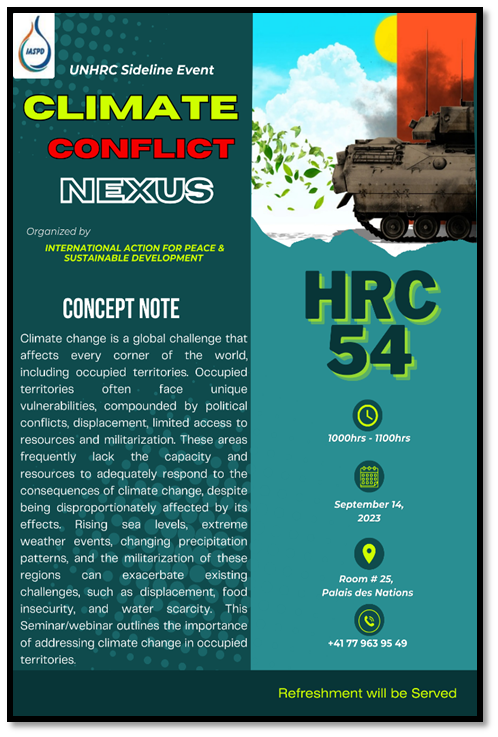
These areas frequently lack the capacity and resources to adequately respond to the consequences of climate change, despite being disproportionately affected by its effects. Rising sea levels, extreme weather events, changing precipitation patterns, and the militarization of these regions can exacerbate existing challenges, such as displacement, food insecurity, and water scarcity.
This Seminar/webinar outlines the importance of addressing climate change in occupied territories.
Opening Remarks:
The event started with an insightful introduction to the perception of climate change threats, natural disasters, why the temperature is rising, and the increase of greenhouse gases, the conflict of climate change will cause security issues, and how climate change will cause the displacement or migration of people, particularly as mentioned in the interpretation of Article 44 of Destruction of Agriculture Land.
Panelist Remarks:
Dr. Shah: Dr. Shah, a decent panelist, regarded that specific increasingly important Security consultation practical in stabilizing According to Refugee in 2019 many people were scored that more than 20% of people in Pakistan survived and their future was forced by displacement.
Kashmir is a designated territory and top Place between India and Pakistan which is affected by climate change directly because of military occupation more than 800 products of the military disrupted the local people with a heavy intense military presence allowing to increase in climate change Kashmir causing mitigation and fundamental rights of Kashmir in civilized society to lock down this isolation they all have to work together to mitigate the risk of climate change in that area.
Highlighted the role of political instability and prolonged conflict in climate change. Noted that addressing climate change impact is more difficult in a large population in India Pakistan. And climate change can be a driver of conflict in cases of depleting resources.
To combat it, there is a need to build resilience, create awareness of fundamental issues, collaborate with state actors, etc., share knowledge, and warning signs, and finally work toward peace.
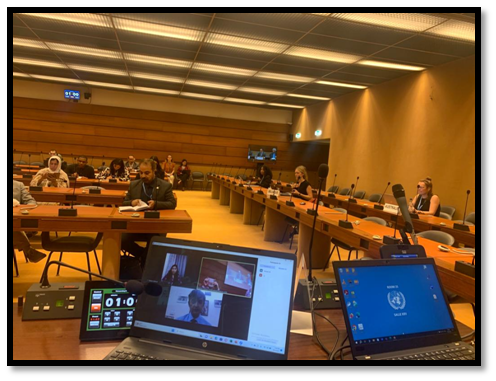
Leon Siu: Mr. Siu foreign minister of Hawaii mentioned the difference of circumstances in Hawaii to control nature from the fire destruction which is all caused by Financial proposes just because of making money also emphasized the adoption of mitigation as our statement also mentioned actions of Western Society about limiting emissions in the island and how they set up their way to adopt the change.
Brought perspective from the Islands as their perspective of climate change may differ from others. He emphasized the role of colonial governments in depleting nature in the past for business and profit making, a consequence the present generation lives with.
Noted that they found local measures of mitigating the impact – adaptation and mitigation. He also raised concerns that when organizations like the UN set aside funds to address climate issues, they approach the execution through control that the colonial leaders push, which is on their terms rather than local integration, and this also has always been unsuccessful.
Mr. Hasan:
He mentioned climate change and how it can affect society and also mentioned equality and society and how governments of failed to prevent climate change.
In 2019 destruction in Kashmir because of climate change, right now Kashmir is the highest zone making it the most militarized zone in the world dealing with conflict and climate change in 2017 August in Kashmir more than 13 villages were caused by the militarization of India and environmental effects.
Highlighted the role of HR in climate issues and the failure of the Government to intervene is a perceived HR violation.
He referenced Kashmiere and the devastating climate impacts they live with, exacerbated by the Indian occupation. Also referenced is the Citon Glacia with 10 tons of plastics and other materials in the environment.
He highlighted other causes unused shells, mines, etc., and how they affect knowledge development, science, research, etc. He advocated Kurami’s release from detention as a human rights defender
Dr Sayra: she explained what climate change will lead to:
-increasing evidence about social-political
– risk High rates of poverty
-escalate aggravated stability and also mentioned the effect of the First Gulf War and how it affected climate change 40% of contaminants were released.
According to Article 44 destruction of agricultural land relationship between climate change and displacement and the predictable ratio and the last main reason is the gap in knowledge of how climate change will increase the vulnerability of people.
Reiterated impact of climate change in those specific contexts – soil contamination, fire in Kuwait oil lakes, mass migration, and how the environment suffers collateral damage.
Cited Art. 54 of Geneva Convention and UNHRC on 45m internal displaced etc. closed with recommendations including supporting those in the frontline of the events and advocacy, management of water resources, use of prevention approach in post-war situation, etc.
Dr. Imtiaz Khan:
he underscored that Kashmir is dealing with environmental terrorism which is caused by the military of India and this colonialism in Kashmir caused many Irrevocable events for example exactly 2 days ago Kashmir had the highest temperature of all time.
Refocused on the issues of the Kashmere as an offshoot of the conflict. Highlighted the origin of the Kashmere conflict as the realization of India’s unwillingness to compromise its stance, resulting in the Kashmir protests and subsequent arrests and detention. Summed that climate change impacts are a direct result of India’s nefarious activities.
Student Ms. Fatma:
She explained about the emergency threats to the security of Kashmir which are caused by the military of India. Noted that the issue of climate change is not to be addressed later but today and now, taking a proactive approach.
last speech
Seyed Muhamad Ali:
he talked about the context of resources, quality of life how the resources would be efficient, and what would be the consequences of using natural resources
he also mentioned that occupied territories in Kashmir not only threatened natural disasters but also security in civil society.
He focused on the global North forces and how they are the major aggressors or actors whose activities worsen climate change impact in the Global South. He traced climate change to be a result of unequal distribution of resources, hence the perception and efforts towards mitigating climate change challenges.
Conclusion:
The UNHCR side event on September 14th, 2023, proved to be a significant milestone in advancing our understanding of the climate change challenges associated with occupied territories such as Kashmir. The meetings highlighted the determined priority of working together to adopt mitigations in climate change
The various understandings and standpoints shared during this event illustrate the ways to address the issues of our responsibilities and how we must continue to pursue innovative solutions to ensure mitigation and adopt climate change.
