
Human Rights to a Healthy Environment
4 March 2025– Room # 25, UNHRC, Geneva & Zoom (Hybrid Event)
International Association for Peace and Sustainable Development, International Women and Children Union & Kashmir Institute of International Relations
Introduction
On 4 March 2025, the International Association for Peace and Sustainable Development (IASPD) and the Kashmir Institute of International Relations (KIIR) organized a special event on the sidelines of the 58th session of the United Nations Human Rights Council (UNHRC) to discuss the challenges of safeguarding environmental rights in conflict-affected regions like Kashmir.
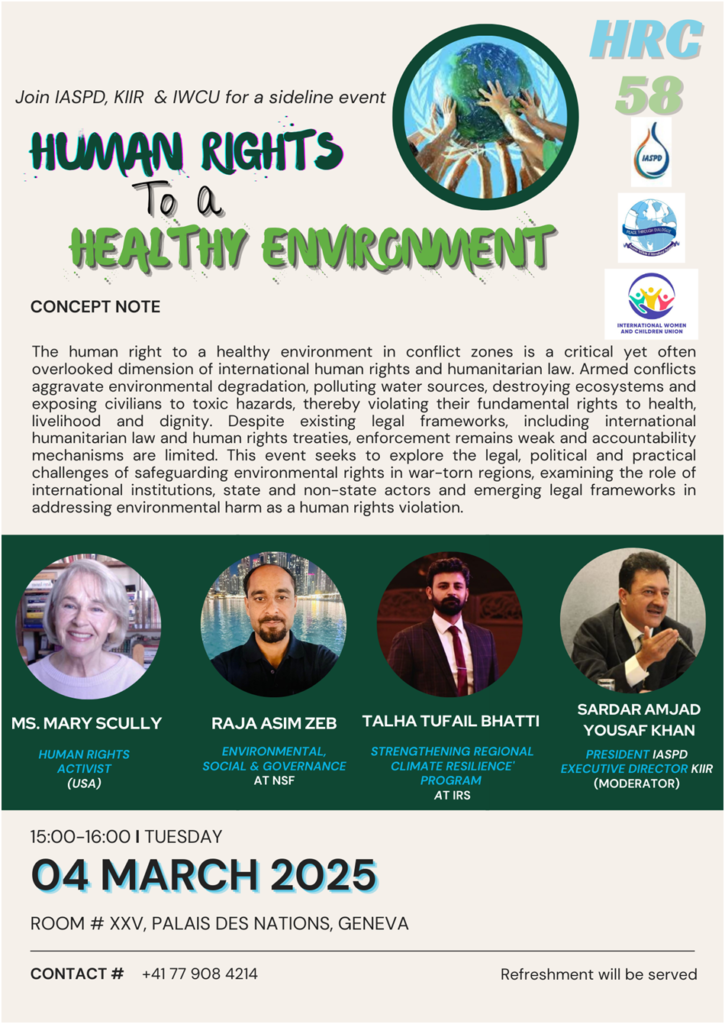
The event brought together international experts, environmental activists and human rights representatives to emphasize the crucial link between a healthy environment and the realization of fundamental human rights.
The event was presided over by Sardar Amjad Yousuf Khan, President of IASPD and Executive Director of KIIR, who, in his opening remarks, underscored the significance of the UN’s landmark resolution recognizing a clean, healthy and sustainable environment as a fundamental human right.
He highlighted that environmental degradation in war-torn regions, particularly Kashmir, is an escalating crisis due to large-scale military presence, heavy artillery use and the destruction of natural resources, leading to glacial melting, deforestation and water scarcity.
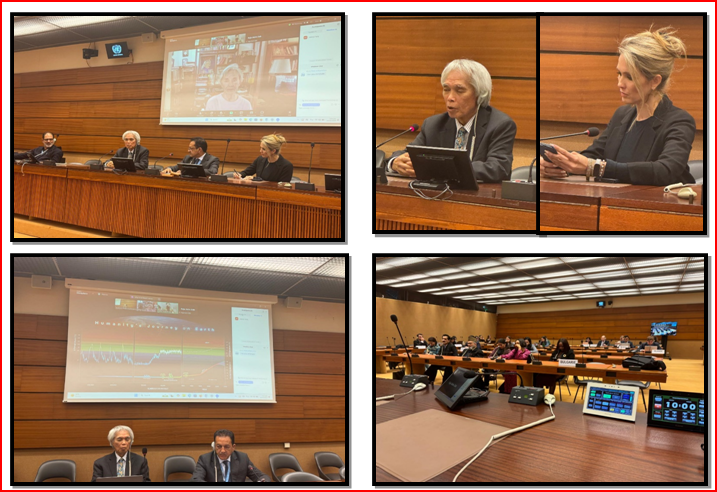
He called upon the international community and organizations like the United Nations to take concrete action against both human rights violations and environmental crimes in Kashmir.
The event was attended by representatives from diplomatic missions of: United Kingdom, Poland, Portugal, Germany, India, Zimbabwe, Morocco, Ireland, Iceland, Costa Rica and Azerbaijan.
Key Themes & Discussions
The event featured a distinguished panel of experts, both in-person and virtually via Zoom, who shared their insights on the intersection of conflict, environmental degradation and human rights.
Mary Scully (Human Rights Activist, USA) – Joined via Zoom
Ms. Scully emphasized the growing recognition of environmental rights as human rights within the international legal framework.
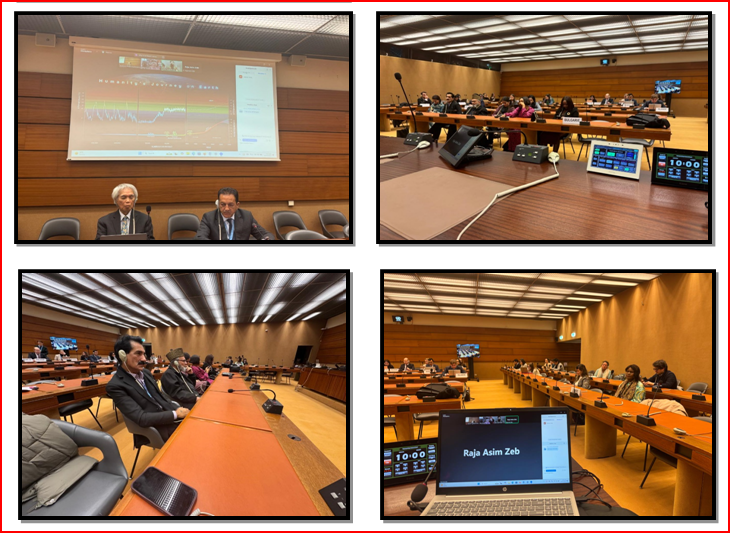
She argued that while the UNHRC resolution on environmental rights is a landmark step, enforcement remains weak, particularly in conflict zones where state and non-state actors violate environmental laws with impunity.
She stressed the need for international accountability and called for environmental justice mechanisms that protect civilians from the consequences of war-induced ecological destruction.
Catherine Cantinstine (Environmental Justice Advocate, France)
Ms. Cantinstine addressed the disproportionate impact of environmental degradation on marginalized communities in conflict zones.
She explained how the destruction of natural resources directly affects vulnerable populations, particularly women, children and indigenous groups, by depriving them of access to clean water, air and food security.
She called for more robust international action to safeguard environmental rights and hold violators accountable.
Leon Sue (Climate Policy Specialist, Germany)
Mr. Sue focused on the global policy implications of environmental destruction in conflicts. He noted that current international frameworks largely ignore the environmental consequences of war, leading to a lack of global responsibility for ecological restoration in post-conflict regions.
He advocated for the integration of environmental sustainability into peacekeeping missions and urged nations to adopt stronger climate policies that address war-driven environmental crises.
Raja Asim Zeb (Environmental Researcher & Policy Analyst, Pakistan) – Joined via Zoom
Mr. Zeb provided an in-depth analysis of the environmental crisis in conflict-affected regions. He noted that conflicts exacerbate environmental vulnerabilities, as seen in Kashmir, where ongoing military operations have led to ecosystem degradation, air and water pollution and loss of biodiversity. ‘
He highlighted that international environmental policies often fail to address conflict-driven ecological destruction, making it imperative for the UN and global policymakers to integrate environmental protection into conflict resolution frameworks.
Sardar Amjad Yousaf Khan (Chief Operating Officer, IASPD & ED, KIIR)
Mr. Khan spoke about the militarization of eco-sensitive areas in Kashmir and its devastating impact on the region’s fragile environment.
He pointed out that military waste disposal, deforestation and destruction of water sources have led to an alarming increase in environmental hazards.
He criticized the lack of accountability for environmental crimes committed in conflict zones, urging global human rights organizations to monitor and document these violations more systematically.
Talha Tufail Bhatti (Legal Expert & Human Rights Defender, Pakistan) – Joined via Zoom
Mr. Bhatti examined the legal dimensions of environmental destruction in war zones. He highlighted that while international humanitarian and environmental laws exist, their implementation in conflict regions remains severely lacking.
He stressed the importance of creating stronger accountability mechanisms to prosecute environmental crimes as human rights violations, particularly in areas like Kashmir, where military actions have long-term ecological and humanitarian consequences.
Recommendations & Actionable Steps
Strengthen International Legal Mechanisms
Develop stronger legal frameworks that hold governments and forces accountable for environmental destruction in conflict zones.
Advocate for environmental crimes to be recognized under international human rights law.
Integrate Environmental Protection into Peace Efforts
UN peacekeeping missions should include environmental restoration as part of post-conflict recovery efforts.
Introduce environmental monitoring mandates for international conflict resolution bodies.
Promote Global Advocacy & Awareness
Mobilize civil society organizations, academic institutions and media to raise awareness about environmental rights violations in war zones.
Strengthen international diplomatic pressure on states violating environmental rights.
The seminar successfully provided a critical platform to discuss the intersection of environmental rights and human rights in conflict zones, with a special focus on Kashmir.
The hybrid format allowed for global participation, with speakers and attendees joining both in person and via Zoom. The discussions reinforced the urgent need for international action to address environmental destruction as a human rights issue.
The organizers, IASPD and KIIR, reaffirmed their commitment to advocating for stronger environmental protections in war-affected regions and called for global solidarity in upholding the right to a clean, healthy and sustainable environment for all.
